My zero Claude project
Last week, at some point, I got annoyed once more by the loose collection of folded-in-half sheets of paper flying around my desk. Those sheets compliment the notebook that I use for more serious™ note taking, and there are always two or three around containing various to do lists. This system of writing and re-writing down when the items clear off has served me well (ish) over the years; however, it also has a number of shortcomings, the most important of which being that I frequently get annoyed by the loose paper I carry around.
So, naturally, I wrote a TUI
Before I did that, over the years, I tried apps other people made. Todoist is great, and I can recommend it. The other one is Obsidian, a tool I use daily for note taking and thought structuring and whatnot, and I also highly recommend it. I looked around the web for a TUI and found nothing that sparked joy. I liked the look of Ultralist, but alas, it is unmaintained (last update 2020) and has a weird looking "Pro" thing that now links to some sports gambling (scam?) site. Pity.
For my to do list - my "list of open points" - nothing has stuck so far; I suspect anything that might must be dumb simple enough for me to just drop stuff into it and keyboard-surf around it, just like I do with pen on paper. Good tools must be invisible.
So now, finally, I wrote a TUI, and you can install it and use it - it's on GitHub, and it's called loop. Here is what it looks like:
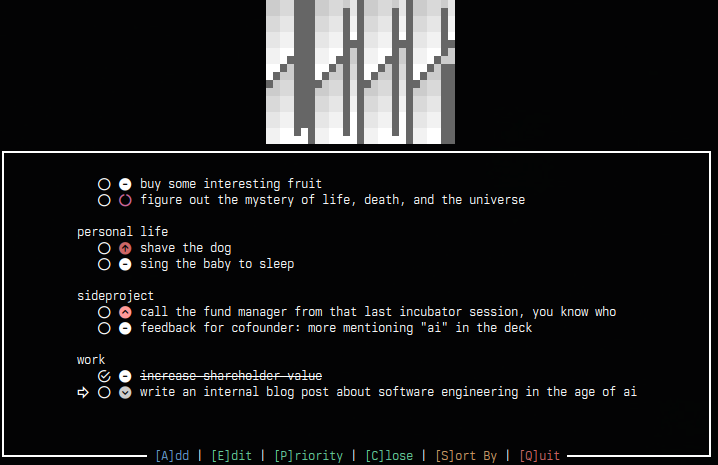
For something quickly thrown together, I don't dislike it. It lives in a narrow terminal window, it's extremely snappy, and it does what I need for now. I might add due dates, recurrence, and perhaps syncing between my devices at some point.
Zero Claude
I like Ratatui, and this looked like the rare good use for it. I thought: this would be fun to do, actually - simple, snappy, I could write this by hand even, in an afternoon, the simplest version in perhaps an hour!
For some reason, I could write this by hand even, in an afternoon! stuck in my head. So, come
Friday evening, I typed cargo new loop-tui into a terminal, and fired up neovim. An hour later I
had a basic version, and another hour later I had some ASCII art for the banner and tasks with a
priority and storing to local JSON, and a bunch more I ended up shelving or redesigning. I would be
lying if I claimed to have used zero Claude here, but it sure wasn't much; I mostly used it like
we used to use web interfaces to LLMs: mainly to have it explain docs and give me snippets to learn
Ratatui faster.
Sure enough, I had something working for my use case within a few hours, and I could've stopped there. But the code was kind of messy and unstructured, and though I could have added a few more features and called it a day, I wasn't happy with that. I was enjoying the process just like I used to, and as I was iterating and restructuring and adding stuff, sometimes using just a bit of Claude but mostly not, I noticed something.
Let's ditch the clankers
Whenever I did use Claude, it produced... slop. I know how that sounds, but in a small codebase that I can hold in my head all at once, it's almost painfully obvious. As I kept refining, it kept churning out slop, and while that was still helpful for me, almost no lines of code it wrote survived. Now of course, it won't be as good with something like Ratatui as it is with more mainstream tech - it's trained on the internet, after all - but it was definitely worse than what I'm used to... I think?
As I iterated on the code between family obligations and walking the dog over the weekend, and it got better and better. It's a small thing, just a toy project, but even so, Claude didn't come along on the journey. It kept helping me through the learning-the-framework moments, but by Sunday morning I had closed Claude Code, and was no longer using it - and that was fine. More than fine, it felt... great?
Michael Crichton1 coined the term Gell-Mann amnesia effect, which describes that a domain expert reading a newspaper article about their field might find the journalist's reporting - which must be based on much less extensive research and knowledge than the expert has done himself - inadequate, but then trusts the same newspaper to provide good information on subject matter they themselves are not an expert in.
This story reminded me of that. Am I simply not seeing the clanker producing slop in places where I don't have, and perhaps can't have, the same depth of context?
You might want to try this
I do have opinions on the current LLM hype, but I'm most definitely not in the "clankers are evil" camp. On the contrary, I use them a lot; the page you're reading has been styled by me telling an LLM what I wanted and it producing CSS, for example. And I don't think the implication you don't recognize the slop because you don't know the codebase fully holds, either. It would be nice if the world were that simple, but I don't believe it is.
It is eye opening, though, to work on a bit of code, small enough to have full context, and see how the LLM fares with it. At least it was for me. I'd be interested to learn if anybody has had a similar experience. Working on loop, it certainly didn't feel like LLMs are the seismic shift we have been led to believe is coming - they are powerful, and I wouldn't want to miss them, but how impactful they can be depends on the context and the way they are used.
Famous last words
With this I have now added another post to the flood of LLM related posts by software people. I'm truly sorry. In truth I just wanted to write something about my to do list TUI, because it was small and fun and wholesome to do.
Me citing him is not to be understood as an endorsement of the man, and even this so-called effect cited here is flawed in my opinion, but for the purposes here, it shall suffice.